I just finished reading the third and fourth books in the Practical Magic series by Alice Hoffman, Magic Lessons and The Book of Magic. I do not exaggerate when I say these books have been life altering for me. They capture so much, I can’t even put a fraction of it into words. All I can say is, go read these magical books!
Now, a thread that runs through all the stories is courage: courage to love, courage to get hurt, courage to take leaps and trust others and trust yourself. This is illustrated throughout the books by the frequent mention of Courage Tea. It’s an old family recipe that dates back to the Owens women who started it all, Hannah and Maria. The recipe has been passed down through the centuries to bolster the Owenses in the face of all the trials and demands of life, as well as those in need they minister to.
Hints of the recipe are dropped throughout the series, but the whole recipe is never explicitly stated. As explained in The Rules of Magic:
“Aunt Isabelle refused to hand over the formula for Courage Tea. That, she said, was one recipe you had to discover for yourself.”
Piecing together the hints and clues of the Courage Tea recipe from the books is actually a pretty fun scavenger hunt. I’ve spent a good deal of time on this exercise, and have filled in the blanks with my own additions as Aunt Isabelle instructed. I encourage you to do the same and come up with your own version if you read the books! But until then, here is my interpretation:
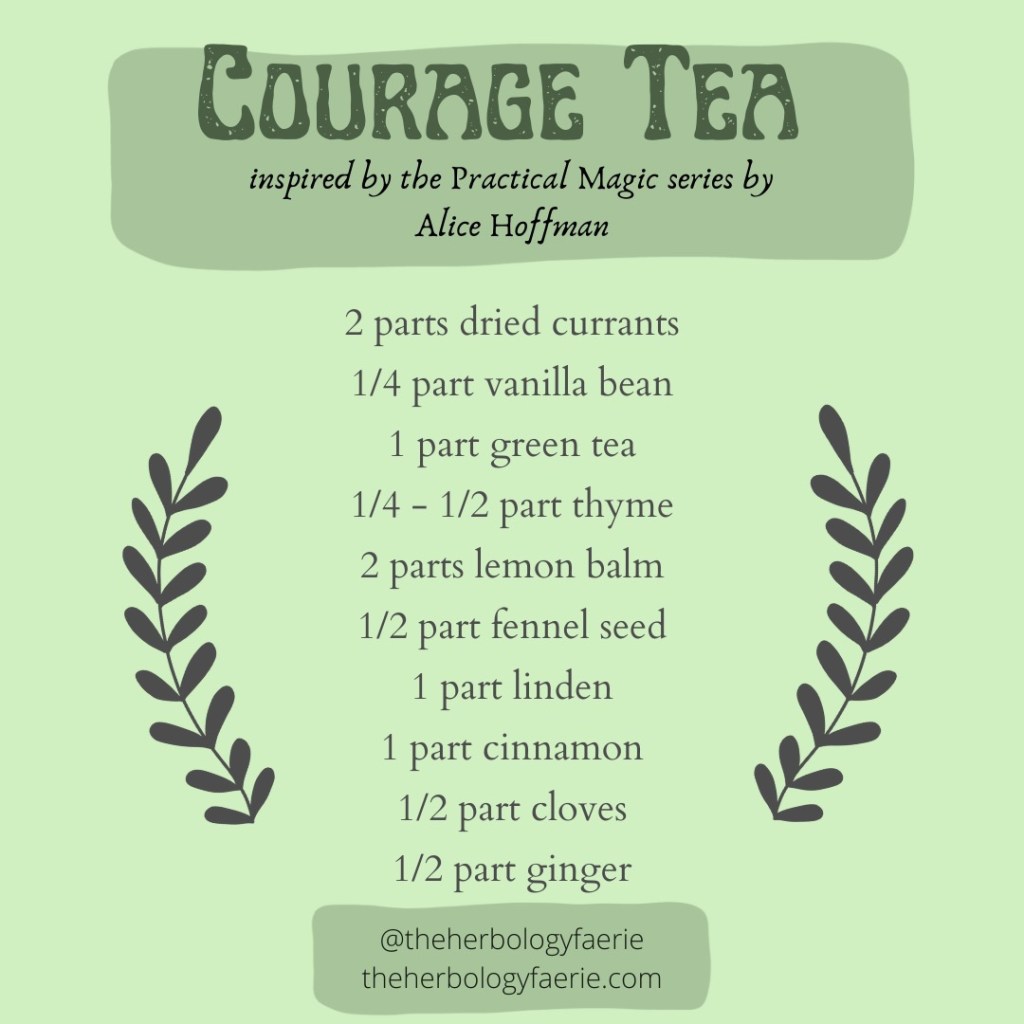
Courage Tea
- 2 parts dried currants
- 1/4 part vanilla bean
- 1 part green tea
- 1/4 – 1/2 part thyme
- 2 parts lemon balm
- 1/2 part fennel seed
- 1 part linden
- 1 part chamomile
- 1/2 part cloves
- 1/2 part ginger
Instructions:
To make a single cup of tea, add 1 tablespoon to a tea strainer, eco-friendly tea bag, or French press. Pour about 1 1⁄2 cups hot water over the tea and steep for 4 to 5 minutes. Add sugar or honey to taste, if desired.
(A few notes on ingredients: I found dried currants at the grocery store but they’re also sold online in some places. I use powdered vanilla bean in tea recipes because it is more affordable than whole vanilla beans while still imparting natural vanilla flavor; you can also add a dash of vanilla extract instead. You may want to adjust the thyme to taste based on how savory you like your tea to taste, as it can be quite strong. And, if you’d prefer a decaf version, you can leave out the green tea or replace it with rooibos.)
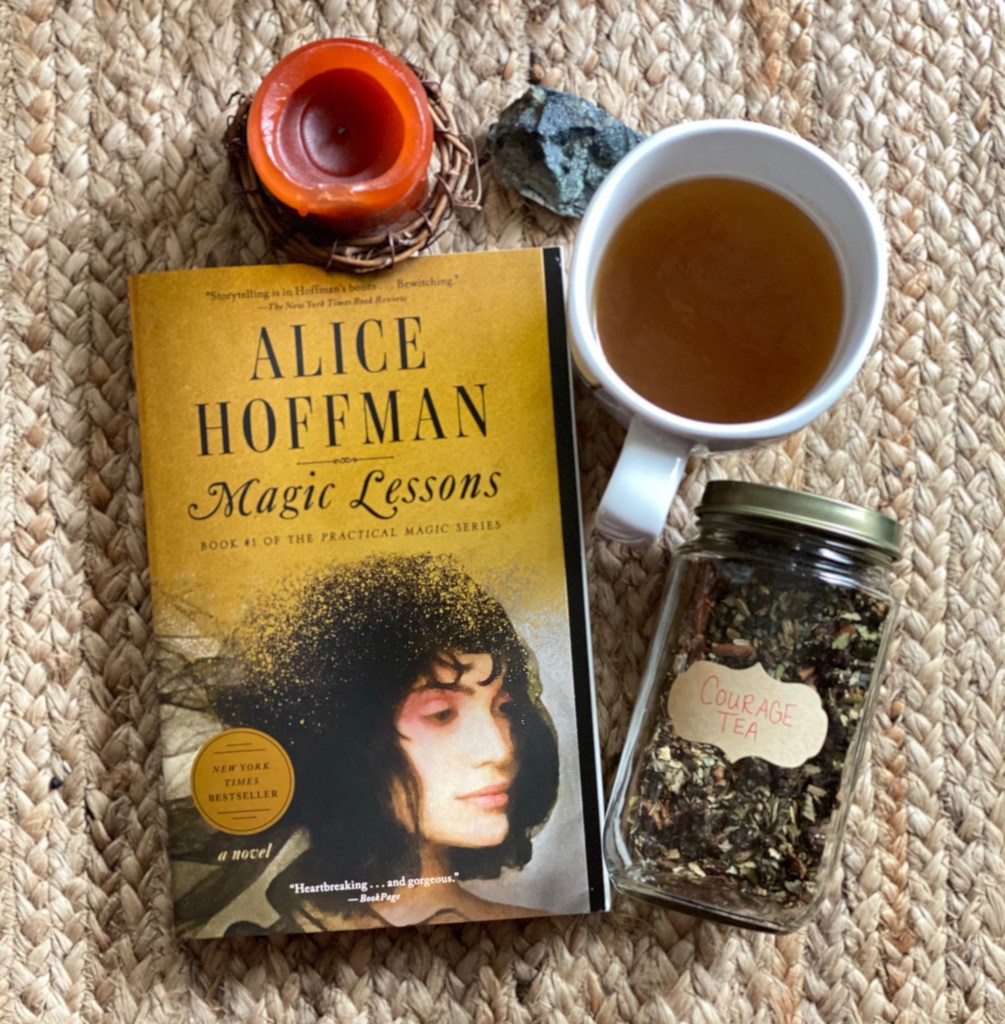
What would you put in your version of Courage Tea?
For educational purposes only. Not intended for medical advice. Always consult your physician.
*This post contains affiliate links, which means if you choose to buy something from a link that I share, I will make a small percentage of the sale *at no extra cost to you*.
 The Herbology Faerie
13 replies on “Courage Tea”
Thanks SO much for this! I have seen *Practical Magic* (for some reason, haven’t read any of the books prior to—>) and also have just finished reading *The Book of Magic*. Wondrous on all levels. ✨ I, too, found myself craving some Courage Tea, and thought I could remember the ingredients listed in *TBoM*—no go! Too many distractions and interruptions before I wrote any of it down. DID remember the dried currants, vanilla and thyme. Figured I’d run a Web search, and discovered your page. Not sure about linden, will see if I can find it; if not, may substitute white pine needles.
Blessed be! 🙌🏼
LikeLike
I’m so glad I’m not the only one who wanted to experience Courage Tea! I also scoured the web for recipes before putting it all together with the info from the books to create this spin. If you really want linden, I’ve purchased it for a good price from mountainroseherbs.com, but white pine sounds like a lovely substitute / personalization. Glad you found your way here 💚💚💚 Blessed be to you!!
LikeLike
I have 2 large Linden trees in my front yard in Grass Valley, CA. They bloom in June (usually) and the blooms are very scented. They really draw the honeybees, and that’s what you hear before you even know the trees are blooming.
LikeLike
That sounds so lovely! I wish we had those around here. The bees certainly know what they’re doing! 🙂
LikeLike
I am on my final book, and so love all of them. I want to make courage tea, and learn much more about all the herbs! Thank you for sharing.
LikeLiked by 1 person
You are so welcome!! It makes me so happy to find others who love this series as much as I do!
LikeLike
I am so excited to make this. I absolutely love the books and the movie!! Thank you for collating this information.
Blessed be !
LikeLiked by 1 person
I hope you enjoy the tea!! The books about the Owens family are some of my very favorites, and I love the movie too. Happy to sleuth out the recipe as best as I could and share it with others! Cheers!
LikeLike
Hello! I’m gathering ingredients to make courage tea, and I was wondering if you measured the parts by mass or volume? For example, a cup of currants is heavier than a cup of lemon balm. Thank you for coming up with this recipe!
LikeLiked by 1 person
That’s a great question! I personally measure ingredients by volume, choosing a base unit of measure depending on the amount of tea I want to make. So, for one cup of tea I’d choose teaspoons, perhaps, and for a large jar I want to store on my apothecary shelf I could choose half cups or even cups. If I was making a medicinal blend where the exact quantities was important, I might measure differently, but it is more to taste and preference in most of my tea recipes.
I’m so glad you found your way here, and I hope you enjoy making and drinking Courage Tea!
LikeLike
Gonna try this, I loved the books
LikeLiked by 1 person
a note about replacing the vanilla – it’s not to do with taste but with using natural ingredients. Witchcraft is about connecting with nature so when making teas (or anything for magic work/intent) it’s best to use the most natural options. Using substitutes could result in synthetics (which is the worst option) or mixed/diluted ingredients. Ultimately, witchcraft is about intent/focus of energies so using alternatives can be done, just remember the more natural everything is the stronger it will aid your goal.
LikeLike
I certainly don’t disagree – natural ingredients are preferable! The vanilla bean powder I use is simply dried vanilla bean husks that the inner portion was already scraped from, ground into a powder to make it go further and not waste any part of the precious vanilla bean. 🤎
LikeLike