Categories
Herbs and Herbalism Recipes

Herbal Spiced “Wine” Tea

Aside from chai, another beverage that I associate with autumn and winter is spiced or mulled wine. The warm, soothing-yet-spirited drink is rich with digestive, warming, and immune-supporting spices. Not to mention how festive and rooted it feels to share this deep, tart ruby liquid with others at a gathering in the colder months.

But! I very rarely imbibe actual spiced wine. Instead, I mix up a similar potion replacing the wine element with extremely beneficial harvest berries and botanicals. They add the same vibrant garnet color, along with nutritional and healing properties, without the alcohol content. An herbal substitute for mulled wine is also quicker and more convenient when you want this type of pick-me-up (any time of day!) and it can be shared with anyone.

You can make your own preferred version of spiced “wine” tea with various ingredients and methods! I’ll share my recipe with you here so you can either use it yourself, or use it as a starting point to concoct your own recipe.

Spiced “Wine” Tea

Rosehips: These tasty red jewels are ready for harvest in October in many locations. You can use fresh or dried (I always have dried rosehips on hand). They add a tart cherry type of flavor, vitamin C, and minerals that aid in heart health, circulation, pain relief, cholesterol and blood pressure health, and even pain.

Elderberries: Dried elderberries impart a deep berry flavor and amazing immune-boosting benefits. Aside from their antiviral properties, elderberries also have anti-inflammatory benefits. I am always conscious to be moderate with the amount of elderberries included, in case of possible digestive discomfort. (I’ve never experienced this side effect myself, but I’ve read that it can happen so I use caution.)

Hawthorn berries: Hawthorn berries add nearly magical benefits of not only boosting heart health in a physical sense, but also soothing and strengthening the emotional heart and aiding with anxiety.

Hibiscus: This is a go-to base ingredient in fruity, berry-flavored teas for me. Hibiscus is an excellent heart ally and gives the tea a full-bodied, cranberry-ish, and even wine-ish taste.

Orange peel, dried or fresh: Obviously vitamin C is a big part of spiced wine. But so is rich, strong flavor! Orange in some form is almost essential to this type of brew.

Spices – cloves, cinnamon, allspice, ginger: You can’t have spiced wine without your warming, grounding, immune-boosting spices! These add taste, physical and mental health benefits, warming cozy comfort, and synergy between ingredients. Of course, you can get creative and use your own favorite combination of mulling spices!

Optional – rooibos: Rooibos is an herbal ally I adore and use often to fill out and add body to teas while providing wonderful benefits. (See my rooibos profile post for more on this herb!)

You can play around with your favorite berries (even adding fresh or dried blackberries or cherries!), spices, flavorings, and even splash in apple cider for a fruity kick or ginger ale for a fizzy twist. It’s up to you how you concoct your festive, warming brew. Then enjoy it all autumn and winter on quiet afternoons or cozy family gatherings! Or take a thermos of it on your outdoor autumn adventures!

What additional or different ingredients are you going to try in your spiced “wine” tea? I’d love to hear so I can try them, too!

Categories
Herbs and Herbalism Tea

Autumn Chai for Health & Grounding

Since tea is my preferred vehicle for herbalism and ritual, I thought today I’d touch on my favorite type of tea during autumn: CHAI. It is full of benefits befitting the season: digestive, circulation-stimulating, warming, anti-inflammatory, immunity-boosting, and so many more. And chai is extremely grounding, protective, and COZY.

So I’m going to touch on a few of my favorite chai botanicals, digging in with a bit of research and preparation ideas.

Origins

I of course have to begin with the origins of chai. Even if what we think of as the “traditional fall spices” that are included in chai go way back, neither the spices nor chai have Western origins. Masala chai hails from India, a centuries-old traditional and health tonic drink. While recipes can vary widely, the main basis includes black tea and warming spices (the words masala chai literally mean “spiced tea”). The Western world recognized the benefits and amazing taste of chai spices long ago and has adopted and adapted them in many ways (which connects to a long and complicated history of colonialism we won’t get into here today). But regardless, chai and its related spices come to us thanks to their ancient origins in India.

There are so many non-traditional and revised spins on chai out there, either to incorporate different flavor profiles or to address varying health concerns. Milk and black pepper are common and traditional ingredients which helps to make the nutrients more bioavailable, but I sometimes enjoy chai without milk or with plant milk. Some versions include berries, fruits, or different herb or tea bases. My favorite base ingredient isn’t even tea—it’s rooibos! But in general, the essential components combine to aid digestion, immunity, and more, making chai a boon to holistic health.

Components

I’ve recently done some research on the specific benefits of some of my favorite chai spices! Read on for a brief run-through of each:

Cinnamon – This warming, drying, pungent bark has anti-microbial, analgesic, antioxidant, and many other qualities and helps with digestion, cramping, regulating blood sugar, soothing sore throats and colds, and more. Folk tradition also holds to other benefits including protection, purification, energizing, healing, love, and prosperity.

Ginger – Another warming, drying botanical. Ginger is a healing powerhouse! It aids in everything from circulation, inflammation, digestion, pain, cramps, cold and flu, sore throats, nausea, heart health, energy, and many more. It is an energizing and synergy-boosting herb, in both health and folk tradition aspects.

Nutmeg – I had no idea of this until recently, but nutmeg is great for stress, anxiety, and insomnia. This pungent, warming, drying spice is also antispasmodic and anti-microbial, along with many other properties. It is also believed to aid in happiness, love, overall health, and psychic abilities, if that’s your thing.

Cloves – Cloves are great for your teeth and breath! They’re also known to be antiviral, antibacterial, anti-fungal, anti-inflammatory, antispasmodic, analgesic, anesthetic, and expectorant. Whew! These fragrant little powerhouses aid digestion, colds and flu, arthritis, pain, headaches, and spasms. Cloves are thought to offer protection, purification, general healing, and mental aid.

Other common chai ingredients include cardamom, allspice, anise, fennel, black tea, and peppercorns. Flavor or health variations can include turmeric, rose, mint, fruit like apple or orange, astragalus, echinacea, reishi…it goes on and on. Don’t be afraid to put your own spin on your chai recipes!

Preparation

Due to the hardy nature of the seeds, roots, barks, and such that make up chai, it’s often suggested to make a decoction with the herbs before combining with the tea component, rather than an infusion. A decoction is simple, though: just boil the ingredients on the stovetop for an extended period (it depends on how concentrated you’re going for, but it can be as little as 15-20 minutes), strain, and add to your brewed black or rooibos tea (if you’re not making a strictly herbal chai). Then top with plant or dairy milk if you like! A decoction tends to turn out more concentrated than a simple tea infusion, so that’s why you often add additional liquid to the mix after decocting. How much liquid you add depends on how long you simmer your decoction.

All that said, though, I often don’t have time to make a decoction and need a quicker cuppa! When this is the case, I grind the spices well with my mortar and pestle (you can use a coffee grinder, too) and steep for longer than I normally would with a simple tea infusion—as much as 10 or 12 minutes.

I could go on and on about chai—I feel like I already have in this post—but I think I’ll stop here for now! Are you a fan of chai? What ingredients do you like to incorporate? Which of the basic chai components is your favorite?

Categories
Hygge wheel of the year

Celebrate Mabon!

This is one of my favorite parts of the year! I’ve always loved it and felt like it was MY time: my birthday on the 21st, the autumnal equinox / Mabon (falling on the 22nd this year), and “Hobbit Day” aka Bilbo and Frodo Baggins’ shared birthday on the 22nd—which to me counts as a holiday itself! But this post is about Mabon, the sabbat marking the beginning of fall and the autumnal equinox on the wheel of the year (in the Northern Hemisphere).

Mabon begins the wind down of the harvest season as autumn starts in earnest and winter approaches. It is an age-old tradition to celebrate this time, which is associated with giving thanks to the Earth for her life-sustaining abundance, the balance of light and dark, and preparing for the colder and darker winter months ahead.

This is such a busy time of year! It can be difficult to pause and reflect with a slower perspective on this seasonal turning. But I have a couple of simple, cozy plans for enjoying and marking this week with my family.

Simmer Pot

My kids actually have a “virtual learning” school day on Wednesday, and it’s supposed to rain all day, too! So it seems the perfect time for a simmer pot. This simple-yet-magical act will set a cozy autumn mood for the equinox.

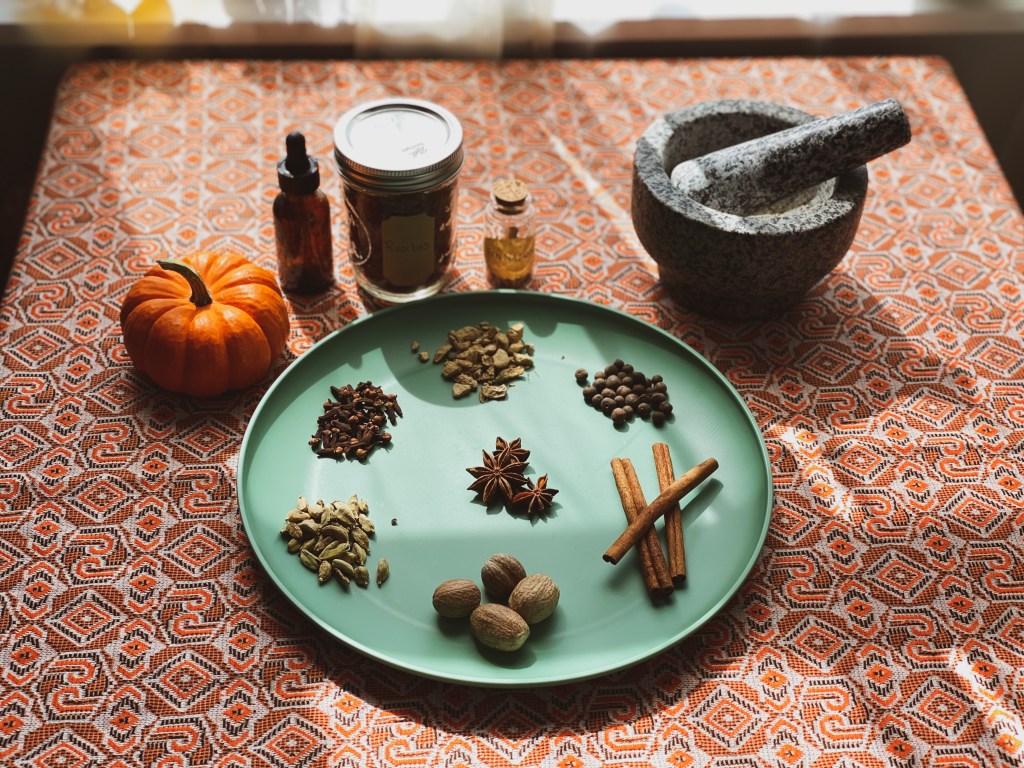
It’s pretty simple: choose aromatic autumn ingredients (I’m using apple slices, a bit of lemon peel, cloves, cinnamon, cardamom, anise, and allspice), add to a pan on the stovetop and cover the ingredients with water, simmer as long as you like, and add more water as needed so it doesn’t dry out and burn. This will fill the house with a delicious scent and all the cozy autumn vibes to put everyone in the spirit of the occasion.

The dry ingredients for my simmer pot!

Pumpkin and Apple Treats

This is such an obvious one, but of course baking favorite apple and/or pumpkin treats is a simple and almost necessary part of a cozy Mabon. (If you are able and if you like apple or pumpkin!) And of course you can totally buy them and skip the diy portion, if you need to or prefer to. The point is, apple and pumpkin are quintessential to the autumn season!

I will likely bake pumpkin muffins for my birthday treat and the autumnal occasion. I have been using the same tried-and-true recipe for something like 13 years now! It’s simple and delicious. (Check it out here!)

I have yet to decide if I’ll bake any apple treats, too, but I’ll at least be making hot spiced cider and apple spiced tea quite a lot this week and through the season ahead! My birthday gift from my parents was a collection of new autumn mugs, which I plan to put to good use!

Chai

Speaking of those mugs, my hobbit-herbalist heart is ready to start brewing up some grounding, earthy, spicy, immunity-boosting chai. I am in the middle of writing a blog post all about this, so I won’t share too much about it now. But, whether you like to make chai from scratch or order a piping hot cup from a coffee shop, this is a great time to think about warming up with chai!

Okayyy…actually, I can’t help sharing one chai tidbit. I was turned onto adding astragalus to chai for an immune boost by Rosalie de la Fôret in her book Alchemy of Herbs and now I rarely make chai without it. Many of the botanicals in chai help boost immunity already, but astragalus adds a sweet and simple way to kick that boost up! I highly recommend trying it (and checking out Rosalie’s book).

Apple Orchard

We are lucky to have a nice apple orchard not too far from us. Due to Covid, we have yet to take our boys there, and our older daughter hasn’t been in a few years. So, we are very excited to hopefully take them over the weekend to enjoy the woods, the animals (it’s a pretty amazing little orchard), and the apples! I can’t wait to restart this autumn tradition.

So, those are a few of the simple ways my family will be celebrating Mabon! Do you mark the autumn equinox? How do you like to celebrate this season?

Categories
Herbs and Herbalism

DIY Herbal Education

(Note: This is NOT a sponsored post. All opinions are my own and I am not paid by any of the below mentioned herbal resources.)

I am a fledgling herbalist on a strict budget. I also want to make sure I am diversifying my educational sources. And, as someone whose goal is to practice home / folk herbalism on a personal level, I don’t need any specific certificate to legitimize my studies. (If you’re someone who does need those things and has funds to invest in your studies, I think that’s awesome! My point is just that it’s only one of many possible herbalist paths.)

Rather than spend what for me is a prohibitive amount of money on in-depth herbalist courses, I’ve taken a different approach. I have put together my own low-cost, piecemeal system for studying herbalism that moves at my chosen pace, prioritizes my values, and feels right to me. If this type of approach speaks to you, I encourage you to do the same! I am going to share a bit about my own journey here to perhaps give you a spark of inspiration and some possible starting points. But, I encourage you to try different methods and resources based on your own situation!

Books

Books are kind of an obvious resource, but it can be overwhelming to know where to start! That can obviously be very personal and dependent on your goals, too. To that end, here is a brief list of a few of my favorite herbalism books—

Alchemy of Herbs by Rosalee de la Forêt

Wild Remedies by Rosalee de la Forêt

Healing Herbal Teas by Sarah Farr

• anything by Rosemary Gladstar

The Illustrated Herbiary by Maia Toll

• DK Encyclopedia of Herbal Medicine

Patreon

I have recently begun following a couple herbalists on Patreon who share a wealth of monthly resources at reasonable prices (with varying tiers based on your needs and ability to give). There are many herbalists doing this on Patreon, and I think it is an amazing approach! I so appreciate these herbalists’ work and how they make herbalism affordable and approachable.
Definitely do your own searching and find the herbalists on Patreon whose offerings are right for you. I have chosen to give my patronage to BIPOC herbalists—here are the ones I follow, in case you’d like to check them out—

Medicine Mija, who is local to me, which is an added bonus in my case! You can also find her on Instagram at @medicinemija and she has a shop you can buy herbal goods, too.

Folk Herbalism for Everyone, who goes by @thehillbillyafrican on Instagram. I love that she includes videos and podcasts, too!

Instagram

Building on that, Instagram is another great resource. There are too many herbalist accounts for me to even begin listing them here, but believe me when I say you can learn so much from them on insta. I’d recommend beginning by searching for the authors of your favorite herbalism books.

Actually…I can’t not share one particular Instagram account. Alexis Nikole, who goes by the handle blackforager, is a joy to watch. Her passion for educating others about foraging for wild and often overlooked foods is fascinating! Do yourself a favor and go follow and learn from her.

Apothecary At Home

I’ve blogged about it before, and I will continue to do so because it is such a great herbalism learning resource! Apothecary At Home is a monthly subscription study box that brings you herbs, supplies, educational materials, and more to help you further your studies at whatever your preferred pace is. It meets you where you are. And you have the option to select individual months based on your desired topics, if you need to be a bit choosy due to funds. The cost is fully worth it considering all the supplies and herbs you get for building your apothecary while you’re building your knowledge, though!

Herb Mentor

There are really good herbal schools that conduct online courses, but the cost can be a bit much for some (like me). However, I’ve found a unique and affordable resource in the platform Herb Mentor from LearningHerbs.com. It brings together a host of articles, monographs, videos, podcasts, herb walks, recipes, video courses, and more for herbalists of all levels and walks. The cost is really reasonable, the scope of information is useful, and the interface is easy to navigate. This is my go-to place to look things up and I love working through the courses at my own speed.
——

Whew! That was a lot. And it’s only the tip of the iceberg. If you are looking to further your herbal studies, there are so many paths to take, and not all of them have to cost a lot. What are some of your favorite ways to study herbalism?

Categories
Herbs and Herbalism

Herb Profile: Rosemary

It’s been awhile, Herbology Faeries! Life has been chaos for me lately, with my wildlings’ school year beginning and all the changes involved with that. But, I am taking a moment to slow down and share with you about a recent favorite herbal ally: rosemary.

Many people think of rosemary as a primarily culinary herb, but it’s so much more than that! There are good reasons the Owens women in the Practical Magic books and movie say to “plant rosemary by your garden gate.”

Rosemary is a pungent, warming, drying, and aromatic herb. According to the plant monograph in Learning Herbs’s Herb Mentor database, rosemary boasts “carminative, circulatory stimulant, hepatic, antimicrobial, stimulating/relaxing nervine, [and] antioxidant” properties. Its uses include “mental stimulation, digestion, colds/flu, fungal infections, hair wash, food preservation, [and] skin protection.” It can be used in many applications, like teas, tinctures, skin and hair products, and food. Traditional wisdom attributes remembrance and protection to rosemary, as well.

Basically, use rosemary as much as you can. It is an herb you can’t go wrong with, because it adds so many benefits to your life and tastes amazing! Lately I have been taking a brain-boosting tincture that includes herbs good for memory and mental acuity like rosemary (of course), gotu kola, ginkgo, and sage. While the intended use of the tincture is for brain health, I notice a very marked calming effect when I take this tincture! Rosemary has always been a culinary favorite of mind, but I’ve also realized that I need to explore more therapeutic and broader uses for the herb because it’s just one that really jives well with me.

And now it’s recipe time! Rosemary pairs amazingly well with grapefruit, so this is a fun fizzy drink (alcoholic or not, it’s equally amazing either way)!

Rosemary Grapefruit Fizz

•Rosemary tincture or bitters (store-bought or homemade; see my post on tincture-making!)

•Grapefruit soda OR grapefruit juice & soda water & simple syrup

•Optional: gin or whiskey
(You could also sub rosemary simple syrup for the tincture / bitters if you’re going the juice and soda water route!)

Are you a fan of rosemary? Which ways do you like to work with this herb?

Categories
wheel of the year

Celebrate Lughnasadh!

In the northern hemisphere, the wheel of the year has turned to Lughnasadh! This August 1st sabbat marks the midpoint between Litha (summer solstice) and Mabon (autumn equinox). Even though Lughnasadh sits squarely within summer, it is the first harvest festival of the year and the kickoff to the harvest season. Lughnasadh is associated with abundance, as well as the sun, the colors yellow and gold, wheat, sunflowers, corn, berries, peppers, tomatoes, squash, beer, and bread.

Since my little wildlings’ schools start right around Lughnasadh, it’s a busy-but-happy time for us. Just like with Litha, I have some low-energy plans to help mark this sabbat in cozy, grounding ways.

Harvest Treat: Herbed Beer Bread

Bread-baking and enjoying is an essential part of Lughnasadh / Lammas (the other name for the day, which means “bread mass”). My favorite type of bread to bake, which is also thematically on-point for this sabbat, is beer bread. It is SUPER quick and easy, yet delicious, hearty, and rustic. It takes very few ingredients and the beer does most of the work for you—no yeast, proofing, or kneading required!

I’ve put together a Lughnasadh bread recipe Pinterest board that you can peruse and come up with a recipe that speaks to you! My plan is to start with a beer bread base using lemon beer, with some seasonally-specific additions, like possibly orange, pumpkin seeds, cardamom, cinnamon, and / or calendula. (Depending on how ambitious I feel this weekend!) These flavors are bright and sweet, with the citrus and spices sort of bridging the gap between summer and autumn.

Check this link for the Pinterest board!

Harvest Sip: Lughnasadh Sun Tea

If you have fresh herbs growing in your garden or window sill, now is the perfect time to harvest some and make a sun tea. But if you don’t have fresh herbs on hand, or you’re just wanting to try a new recipe, here is the potion I’m brewing for Lughnasadh:

3 parts green rooibos (or green tea)

2 parts tulsi

2 parts lemon balm (fresh or dried)

1.5 parts cinnamon chips

1 part dried orange peel OR some fresh orange slices

Dried or fresh pears, peaches, and/or lemon

Harvest Fun: Sunflower Picking and Harvest Decorating

Mr. Herbology Faerie likes to tease me by fake-complaining when I decorate the house for fall before September 1st. Which I usually ignore! This year will be no exception, though I do plan to hold off on pumpkins and leaves until September. Instead, I’ll focus on sunflowers, wheat, gourds, and yellow in honor of Lughnasadh. Decorating for the sabbats can be a cozy and therapeutic way to ground yourself in the season!

A fun family activity I’m hoping we squeeze in on Lughnasadh weekend is sunflower picking at a local flower farm. We went last year a little too late in the season to get any sunflowers; this year the plan is to head there in time for a sunflower bouquet for Lughnasadh.

Those are some of my low-key plans for celebrating Lughnasadh and the start of the harvest season! How are you planning to celebrate?

Categories
Herbs and Herbalism

Tinctures for Home Herbalists

If you’re more of a hobby herbalist like me, or if you’re new to herbalism, tinctures may feel a little daunting. Herbal teas seem less intense, due to their simpler water-based preparation and short wait time. It feels like you can’t mess a tea up! But tinctures are a bit more intimidating to beginners, or at least they have been to me. So today, I’m sharing what I’ve learned about tinctures including different types, methods, and uses.

Let’s start with demystifying the various types of tinctures with a little list—

Tincture: An herbal preparation made by macerating (soaking) herbs in menstruum (alcohol, usually vodka) for a period of weeks. The alcohol extracts helpful components from the herbs and creates a highly concentrated liquid that is typically ingested by the dropper full, alone or mixed with other liquids.

Bitters: You may hear this term specifically in regard to cocktails, culinary uses, or digestive aids. Well, guess what…bitters are the same thing as a tincture! It’s just a bit of a more specific term regarding use—the bitter component is the star and can be used to impart flavor and/or stimulate the liver and digestion.

Elixir: A tincture made with a sweetening agent, usually honey. Elixirs have a shorter shelf-life than tinctures without sugar.

Glycerite: A tincture made with vegetable glycerine instead of alcohol. Often used by kids and those who obstain from alcohol completely (though the alcohol in a tincture dose is minimal). Glycerine typically works better with fresh plant material than dried.

I started out by making elixirs, because honey seemed like a no-brainer to make tinctures more palatable. I also began with multi-herb combos and even different types of alcohol. I don’t recommend any of the above for beginners! My elixirs didn’t always keep fresh for long, sometimes tasting “off” far too soon after straining and bottling. Definitely consider an online class, YouTube video, herbalist’s Patreon, or recipe book’s guidance when making your first tinctures, and keep it simple: one herb and vodka.

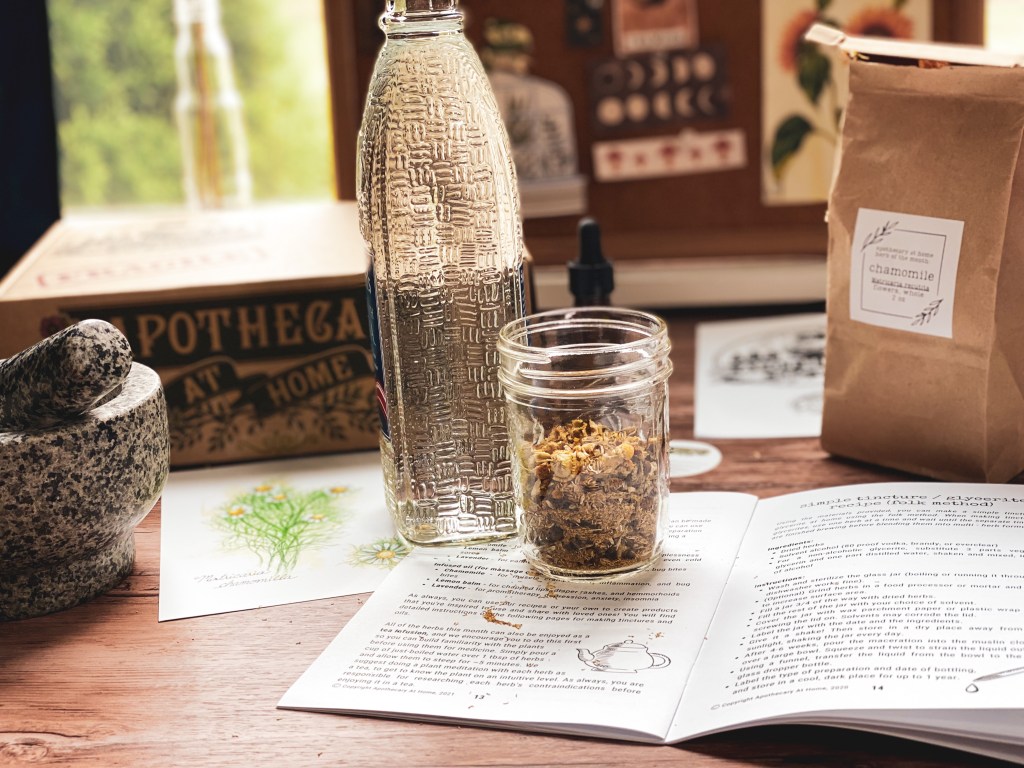
Making a chamomile tincture with guidance from Apothecary At Home

I am not going to go into super depth about the process of making tinctures because I am not an expert herbalist by any means. As I mentioned, I recommend seeking expert guidance for tincture-making, which is what I always do. But here is a brief outline of the process:

Generally, you want to fill a small, sterilized glass jar 3/4 full with dried herb, fill with enough vodka to cover the herb completely, and cap tightly with waxed paper under the lid. Label it with the date made and the date it should be ready, as well as the contents. Keep in a cool dark place, and shake daily. After around 6 weeks, strain and bottle in small, dark glass bottles or jars.

Some great starter herbs for tinctures that are useful in both medicinal and culinary respects include lavender, lemon balm, dandelion root, tulsi, rose hip, hawthorn berry, or juniper berry. These all have various health-supportive uses, like vitamin and mineral supplementation, immune system boosting, and even anxiety, inflammation, and heart support. Plus they taste great!

Tinctures are super convenient once bottled! You can take doses straight if you prefer—a few drops to one dropper full, either straight on or held under the tongue for several seconds. You can also add the same amount to plain water, fizzy water, tea, or even cocktails. A refreshing combo I really love in the summer is lemon lime soda, frozen fruit, and a dropper of fresh lemon balm tincture (which I didn’t make; I bought it from Raven Energy Herbal Apothecary on Instagram).

So, do tinctures seem any less daunting to you now? Or are you already a tincture expert? I’d love to chat about this useful herbal potion in the comments!

Categories
Apothecary At Home Herbs and Herbalism

Apothecary At Home: Mental Health Mastery Study Box

I am so excited to share with you a new way to study herbalism that I’ve discovered! I am partnering with Apothecary At Home, a monthly subscription service sending monthly herbalism study boxes based around health-supportive themes.

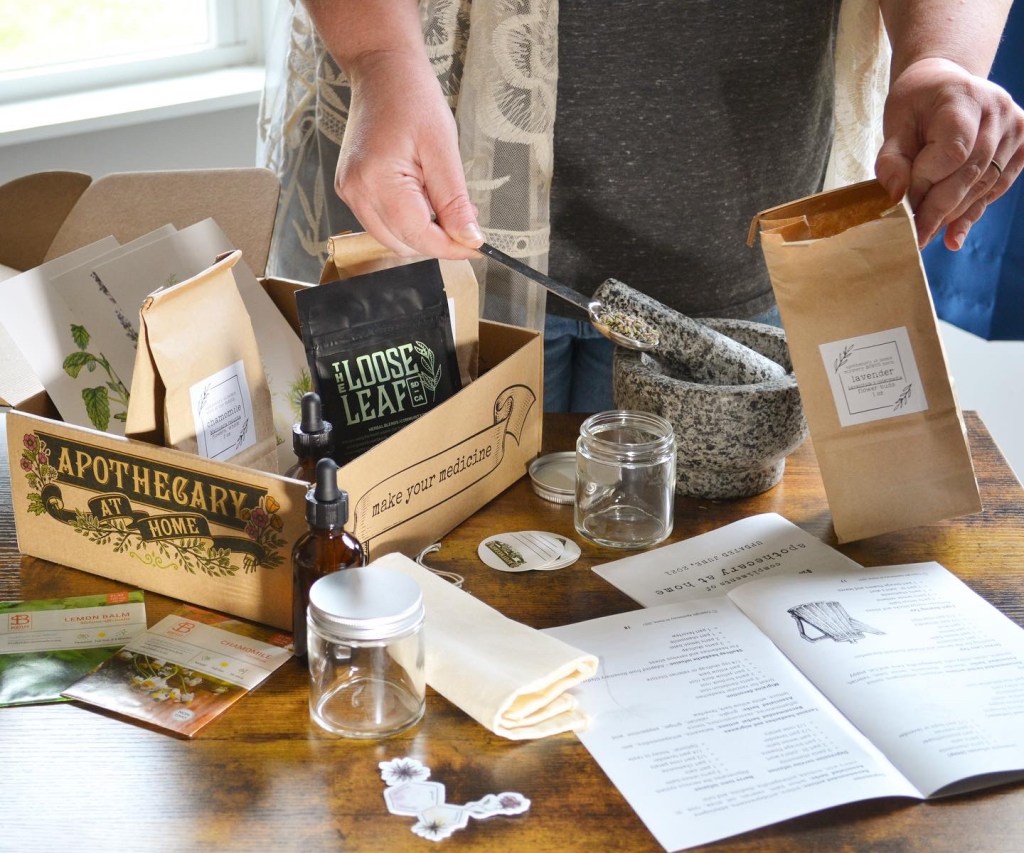
Each box contains generous quantities of dried herbs (two features herbs plus one mystery herb); supplies like bottles, labels, and muslin straining bags; a highly detailed, deeply researched study guide with monographs, recipes, instructions, book recommendations, and more; original plant monograph artwork; and fun extras like tea blends, stickers, and more. You are encouraged to work at your own pace and comfort level with the supplied materials to gain a hands-on relationship with herbalism.

I adore the practical, experience-centered approach to this study box. There is no better way to learn herbalism than hands-on with the herbs themselves, and Apothecary At Home brings herbalism class straight to your mailbox so you can do just that. They also offer additional support including an exclusive Facebook community for students and optional monthly Zoom classes centered around each theme! If connecting with other herbalism students at all levels is of interest for you, AAH even creates opportunities for that. And beyond the obvious benefits of teaching you how to create your own herbal medicine, there is something so therapeutic, grounding, connecting, and creatively fulfilling about working with this box.

I feel like a sweet granny witch in her cottage mixing potions when I work with this box!

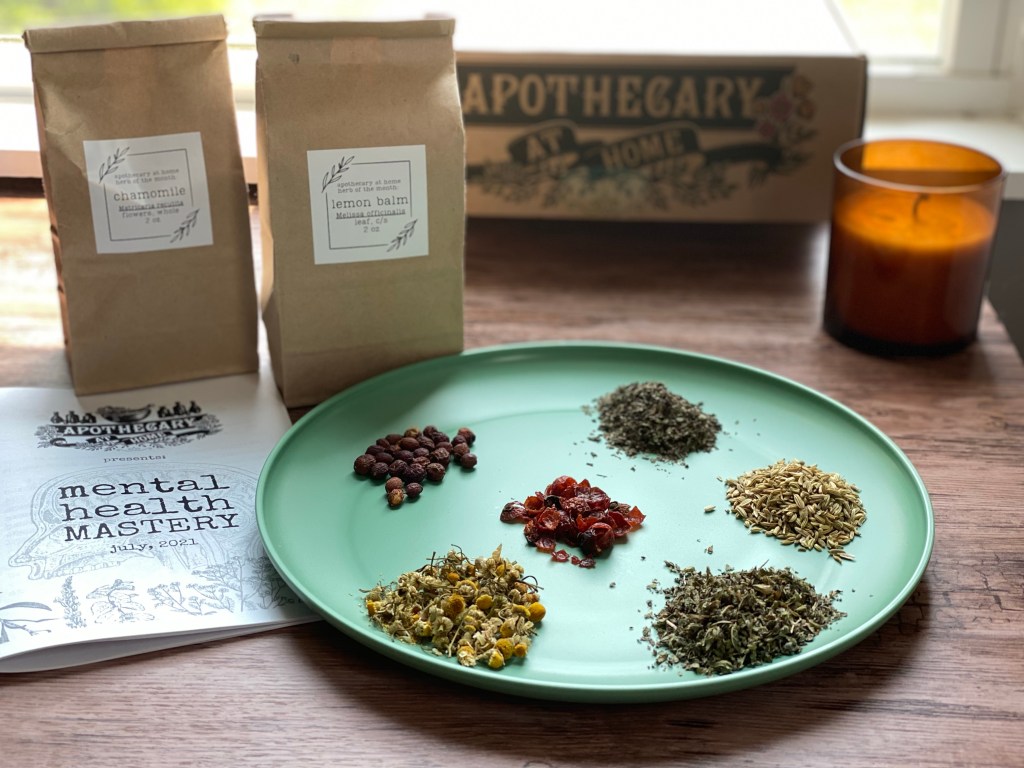
The theme for July’s box is Mental Health Mastery, a topic that is universally useful! With relaxing nervine herbs like chamomile, lemon balm, and lavender, you have nearly everything you need to create your own teas, tinctures, bath soaks, aromatherapy aids, and other preparations to relieve stress, ease anxiety and depression, help you sleep, soothe digestion, and more.

I have already begun creating remedies from this box and I am really enjoying the experience. I’m loving the tea recipes—I have mixed up a jar of Stress Less tea and last night I slept like a baby after drinking a strong cup of it! I plan to begin work on a couple of soothing tinctures next using the study guide. As someone who is already somewhat versed on these herbalism topics, I can say I’ve already learned new information and perspectives from my studies with this box!

I can’t recommend Apothecary At Home enough! I highly recommend checking out their lovely Instagram account to connect with them and see if it would be a good fit for you. They have a new additional tier of educational box in the works, too, so stay tuned to their social media for info on that. And watch this space for more peeks at their recipes and boxes!

Categories
wheel of the year

Celebrate Litha!

If you’re in the northern hemisphere like me, then the summer solstice, or Litha, is approaching! To me, there is nothing more hygge than aligning yourself with the seasons, the natural world around you, and traditions associated with each spoke on the wheel of the year.

To that end, this week I have a few super simple, low-energy activities planned to do with my kids. I am all for low-cost, low-prep ways to ground yourself in the season and reap what it has to offer. But I never seem to have time or energy to put a ton of effort into anything elaborate. That’s not really necessary, though! Do things up as big or as small as you like, but in my opinion, simplicity never goes amiss.

Summer Treats: Fruit Salad, Herbed Lemon Bars, Popsicles

The summer solstice revolves around the idea of transformation. The fruits of the season are ripe for the picking! So I’ve been making super simple fruit salads with local fruits, fresh herbs, raw honey, and squeezed citrus. This is an excellent way to experience the transformation of spring blossoms into summer bounty.

Watermelon, strawberry, peach, basil, lime, and honey fruit salad

Later this week, the kids and I plan to also incorporate some of those fresh fruits and herbs in simple homemade ice pops! We are going to add vanilla yogurt (you can use dairy or plant-based) to make it a creamy, satisfying treat.

Finally, lemon bars are a summer favorite of mine. Add summer rosemary or lavender, and you’ve got a festive, cottagecore-worthy baked treat! While you can find some excellent recipes on Pinterest, I am probably just going to make a boxed mix and add my own herbs in. (No shame in the boxed mix game!)

Summer Sips: Cooling Iced Sun Teas

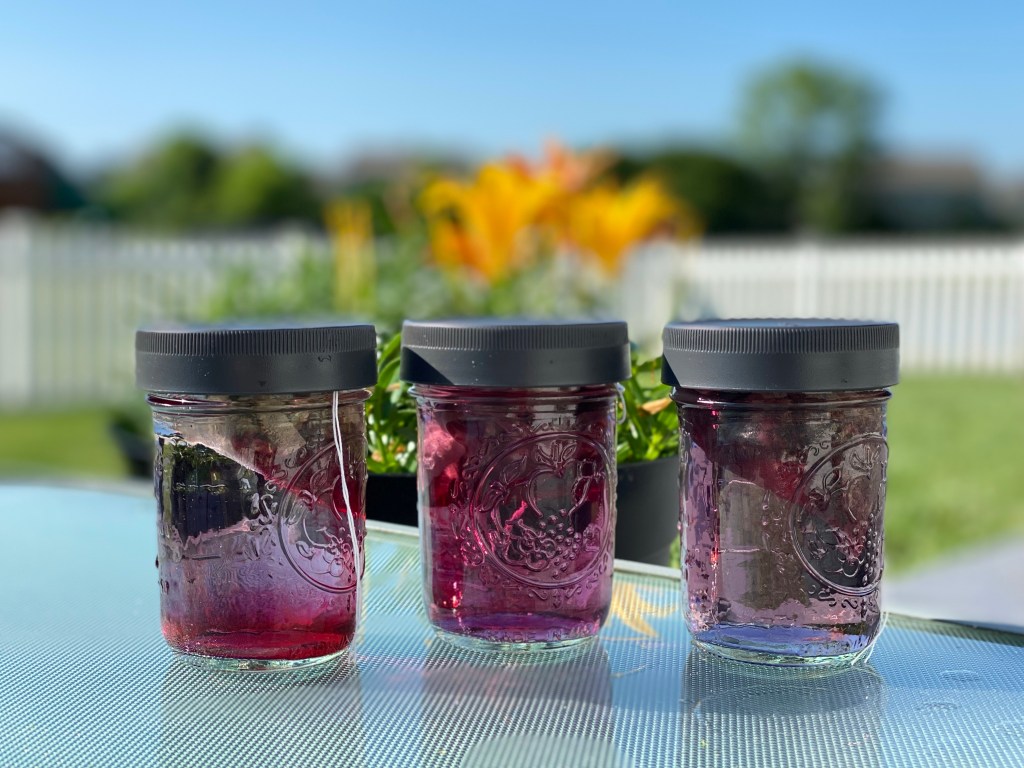
You can’t beat the power of the sun to brew tea. It’s so simple, and you feel like you’re sipping on summer sunshine when you drink your brews! Just add about a tablespoon of herbs per cup of water in a tea strainer or eco-friendly paper teabag, place in a glass jar, fill with cold water and put the lid on tightly, and leave in full sun for 2-4 hours. I sometimes stir in a bit of sweetener (honey works great or your own choice of sweetener), place in the fridge for several hours, and then sip straight from the jar with a reusable straw.

I have been mixing up hibiscus-based teas for the kids and I lately. Hibiscus is a delightfully tart, cooling botanical that is perfect for hot summer weather. It tastes a lot like cranberry juice as an iced tea, so it’s great for kids! Hibiscus is also known to be beneficial for your heart, circulation, and blood pressure.

Little jars of hibiscus sun tea for the kids!

Here are my two favorite hibiscus blends:

Hibiscus, mint, lemon balm, chamomile, blueberries

Hibiscus, lemongrass, orange peel, rooibos, mint, calendula, gotu kola

Summer Moments: Fires and Flowers

Recently we took the kids for their first trip to a “beach,” at one of the largest lakes in our state. We had a blast swimming and playing in the sand! If you are lucky enough to live near a lake or ocean, it’s obviously a fun way to experience some nature in the summer sun.

Most of my plans for marking the solstice are much lower key, however. Taking evening walks when the heat of the day has just passed, burning citronella candles on the back porch (we don’t even have a fire pit, let alone a place for a bonfire!), and maybe making a craft from spent flower petals are all possibilities on the list.

So, those are some of my simple plans for celebrating Litha / the summer solstice this week! How are you planning to celebrate?

Categories
Herbalism in Fiction

Herbalism in Fiction: Practical Magic

If you read my previous Herbalism in Fiction post, you know I have very specific taste in favorite books, namely varying types of fiction featuring herbalism and absorbing, immersive imagery and description. The next book I’m going to touch on is a new favorite of mine, but by no means new: Practical Magic by Alice Hoffman.

To preface: I’ve heard excellent things about the film; though I haven’t seen it yet, and am very excited to, I’ve heard the overall tone of the film and book diverge a bit. I have a feeling it’s one of those cases where they are separate pieces of fiction that stand up in their own ways.

The book is a complex and magical tapestry woven with strands of sisterhood, womanhood, family ties and legacies, love and loss, the magical and the mundane, uniqueness and self-acceptance. The story begins with two little orphaned sisters, Sally and Gillian Owens, who go to live with their elderly witch aunts in the family’s curious, mysterious old home in Massachusetts. As the girls grow up and go their separate ways, forging paths for themselves in life, they find themselves ultimately needing that family magic in their lives despite their efforts to grow away from it.

Practical Magic is a mixture of literary fiction and magical realism, with heartwarming notes, dark and spooky threads, cozy and immersive imagery, painful beauty, and just the right bits of levity thrown in the mix. It is really a unique work of literature that will really pull at your heartstrings and ignite your imagination if you’ll let it!

As far as this book’s herbalism connection, it is an inextricable part of the dense palette of the story. Lush, vivid descriptions of the aunts’ herb garden, frequent recurrences of lavender and rosemary, mention of concoctions and poisons, and THAT lilac bush (when you read it, you’ll know!) put this book squarely on my list. And the aunts’ house with its dark corners, chandeliers, big window seat, mysterious portrait, and self-dusting woodwork (yes, please!) add just the hygge element I’m always searching for in books, too.

I am so glad I finally read this book! Not only does it tick all my boxes, but the story itself is both deep and thought-provoking while also lovely and sweet, ultimately. And there are a few other books about the renowned Owens women in publication or to come, which promises more books for this list!