Categories
Botanical Anthology Recipes

Lemon Balm Sugar Cookies

This is an excerpt from the article Lemon Balm Sugar Cookies by Kristine Brown from the Herbal Cookie Tray Vol 2 booklet featured as the bonus for the Winter Vol 3 | Issue 11 | 2024 edition of Botanical Anthology. To learn more about the ingredients and uses of this recipe, check out the entire article in the magazine! Our herbal magazine, featuring remedies, recipes and projects with plants for the winter season, can be purchased as a Digital version: HERE and as a Print version: HERE.


Lemon Balm Sugar Cookies

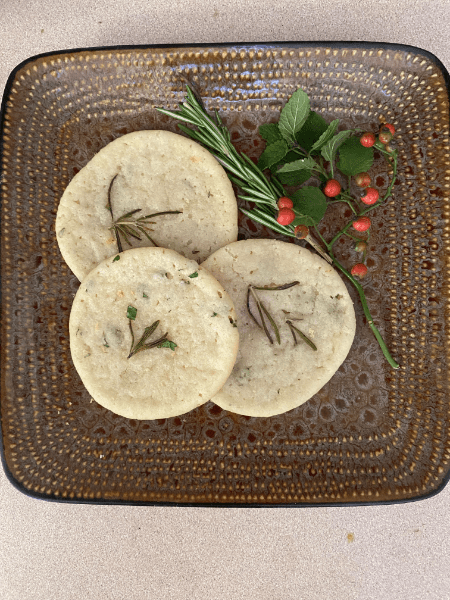
Make delightful sugar cookies that melt-in-your-mouth good! The mild lemon flavor adds a delicate blend of tang that compliments the savory rosemary flavor from the garnish perfectly. They can be prepped a day or two ahead so you can cut and bake when you’re ready.
Materials

2 tbsp lemon balm, minced
1 tsp lemon juice
1 c butter, softened
⅔ c sugar
1 egg
2 ⅓ c all-purpose flour
Sprigs of rosemary for garnish

Method

In a small bowl, combine lemon balm and lemon juice, pressing the mixture with the back of a spoon to blend. 

In a large mixing bowl with a hand mixer, cream butter and sugar until light and fluffy. Beat in the egg and the lemon mixture. Gradually beat in flour and salt. 

Cover and refrigerate 3 hours or until firm enough to roll in wax paper. 

Preheat the oven to 350°F. Place the dough on waxed paper and slice into slices about 1/8″ thick. Press bits of rosemary sprigs into each cookie to look like a pine tree. 

Bake on an ungreased cookie sheet for 8 to 10 minutes. Cookies will brown slightly around edges. 

Notes

  • Yields about 60 cookies. 
  • If you are using dried lemon balm, you will only need about 1 tablespoon.
  • This recipe can be made gluten free by substituting 1:1 gluten free flour blend for the all-purpose flour. 
  • This recipe can be made dairy free by substituting coconut oil or tallow for the butter. 
Kristine Brown, RH (AHG) is the writer and illustrator of the children’s publication Herbal Roots zine, which includes ebooks, online courses, and a membership offering, Herb Club. She is the author of Herbalism at Home, The Homesteader’s Guide to Growing Herbs, and Nature Anatomy Activities for Kids and Nature Anatomy Guided Journal for Kids. Find her online at herbalrootszine.com and on social media @herbalrootszine

Categories
Herbs and Herbalism plant wonder collective Recipes

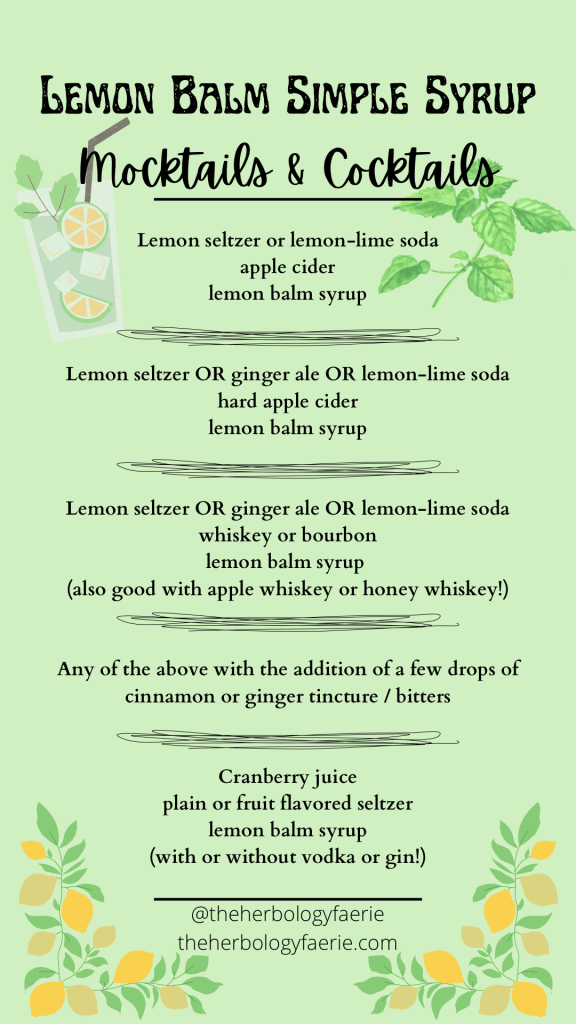
Lemon Balm Simple Syrup Mocktails & Cocktails

Happy Tuesday! Whether you’re here from my Instagram post or you found this blog post first, welcome to the lemon balm party!

Lemon balm is a subtle but sweet and tasty herb for making simple syrup. I decided to brew some up and then experiment with using it to create some tasty mocktails and cocktails.

I used fresh lemon balm to make a small batch of simple syrup with my usual recipe: dissolve ½ cup of sugar in ½ cup of water on the stovetop over medium heat, add in about 1 cup of the herb, remove from heat and steep for 30 minutes, strain, and refrigerate for up to 2 weeks. 

Then came the fun part! Of course, you can use the syrup in any kind of tea (black, green, herbal) for a bit of sweetness and the calming, soothing effects of lemon balm. But I decided to take a few diy concoctions for a spin! My favorite combination was ginger ale, a splash of apple cider (apple juice works too), and about a tablespoon of lemon balm simple syrup. If you find your lemon balm syrup’s flavor turned out too subtle, though, you can always just combine it with seltzer or ginger ale so it can be the star of the show. 

There are plenty more ways to combine lemon balm simple syrup in other mocktails and cocktails, too. Here are some of my favorite combinations!

Follow along for more Lemon Balm wonder throughout the day and join us this month through our hashtags and at @plantwondercollective on Instagram!

#plantwondercollective

#pwclemonbalm

Meet the participants!

@plantwondercollective

@florasfeastbotanicals

@wineberryadventurescouts

@herbalfae

@mamalibelula

@theherbologyfaerie

@herbal_pirate

@katwb444

Plant Wonder Collective: Connecting you to nature through food, drink, play, garden, medicine, magic and art.

Categories
Herbs and Herbalism plant wonder collective

Herb Profile: Lemon Balm

Happy September! It’s a new month (one of the best ones!) and time for a new plant profile. Since I’ve officially joined in on the Plant Wonder Collective on Instagram, I’m going to begin featuring the PWC herb of the month in my plant profile blog posts to coincide. So, for September, let’s take a look at lemon balm!

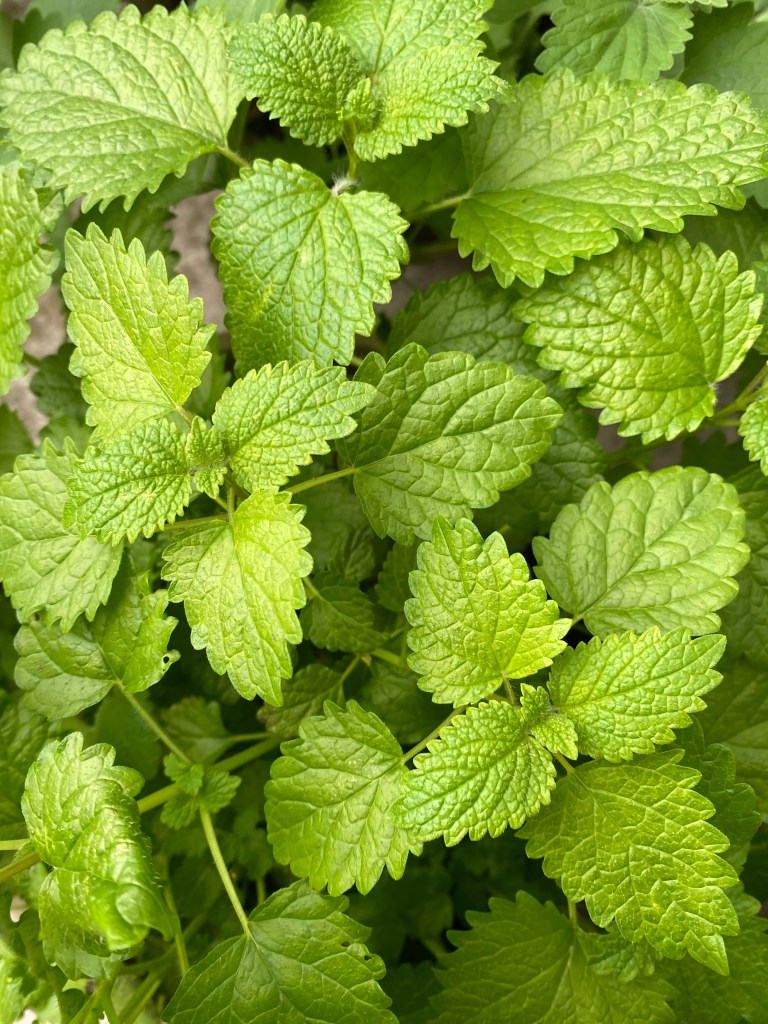
I think of lemon balm as being one of the most “chill” herbs I’ve had the pleasure to befriend and work with. The spirit of this plant is so happy, cheerful, and uplifting. And its scent and taste are, too! It should come as no surprise, then, that lemon balm is considered a relaxing nervine herb. But it is so much more than that, too!

Originally native to southern and Central Europe, the Middle East, and parts of Asia, lemon balm is now much more widespread in its naturalization. One thing I find fascinating about lemon balm is its varied recorded historical uses—from the Greeks and Romans, to the Middle Ages, and beyond. It was a favorite strewing herb and had many medicinal, culinary, and even perfuming applications. In folklore, lemon balm is associated with protection and joy (echoing its medicinal qualities) and is associated with the goddess Diana.

Lemon balm has a primarily sour taste (though many find it sweet as well) and is energetically cooling and drying. It has a wide range of properties—relaxing nervine, antiviral and antimicrobial, antioxidant, antispasmodic, digestant, and probably more. Lemon balm is well known as a gentle, safe aid for stress, anxiety, indigestion, nausea, and insomnia. It is also helpful for colds, fever, flu, and other infections, as well as topically for rashes, small wounds, and bug bites. It is great for the heart, cognitive function, and pain, and can help with depression and seasonal affective disorder as well.

One thing I’ve observed about lemon balm is that it smells and tastes much more potent and lemony when fresh. Dried lemon balm is equally useful and you’ll find it in many herbal teas, but nothing compares to fresh lemon balm. If you don’t have access to garden space, this is one herb you’ll definitely want to consider growing in a sunny windowsill!

I’ll be sharing more lemon balm recipes both here and over on Instagram throughout September, but I’ll leave you with one of the simplest and most soothing tea recipes I’ve encountered. It’s a classic you’re sure to have seen before on other recipe blogs or books, or even in a supermarket tea. There is a reason for that! It tastes wonderful cold or hot, it’s safe for kids and adults, and it is a gently relaxing tea to help with stress, anxiety, depression, digestion, colds, and insomnia.

Simple Soother:

1 part lemon balm

1 part chamomile

½ part lavender

That’s it! You can use fresh or dried herbs interchangeably in this recipe; I use what I have on hand. I like to cold brew big jars of this overnight and sip it any time of the day. I also share it with my kids, because they love it!

Are you a lemon balm lover? What is your favorite way to work with lemon balm?

———

Sources:

• Rosalee de la Foret, Herb Mentor monograph

• Rebecca Beyer, Wild Witchcraft

• Sarah Farr, Healing Herbal Teas

• Tina Sams, Herbal Medicine for Emotional Healing

Categories
Herbs and Herbalism

Recharging Your Battery With Nervine Herbs

I can’t believe it’s almost June! May has really flown by. Before mental health month is over, I thought I would jump on the blog and talk a bit about one of my favorite types of mental health support: nervine herbs!

Many nervine herbs are gentle and safe for frequent use and can be a part of your daily mental health support regimen. Nervines are known for their benefits to the nervous system, hence the name. They support, tone, nourish, and soothe, offering us calming, anti-anxiety, digestion soothing, pain relieving, and grounding benefits, among many others.

Here are a few of my favorite nervine herbs:

Chamomile

Rosemary (relaxing / stimulating)

Tulsi

Lavender

Lemon balm

Linden

Hawthorn

Elderflower

Rose

Passionflower

Skullcap

Peppermint (stimulating)

Cacao (stimulating)

Most of the preceding list of herbs are normally categorized as relaxing nervines. Relaxing nervines do just what they sound like: they help to relax your nervous system. Stimulating nervines don’t stimulate in the caffeine sense; instead, they are uplifting and stimulate digestion. And some nervines do both at the same time! Also, each different nervine has its own particular chemical constituents that aid in different ways on top of the nervine qualities. For example, hawthorn is amazing for heart health, passionflower and skullcap are helpful in aiding sleep, and chamomile is known especially for helping with pain, cramps, indigestion, and fever.

As with anything, consult your doctor as needed and don’t take huge doses of any herb over short periods of time. But do think about branching out and trying different nervines to see what works well to support your particular needs. 

And since summer is fast approaching here in the northern hemisphere, I am going to leave you with a simple, cooling and soothing infusion recipe featuring nervine herbs. This is a favorite of mine! You can make this with fresh or dried herbs (I grow all of these in my mini herb garden); drink it hot or cold (my summer preference is definitely cold); and sun brew, cold brew overnight in the fridge, or infuse with hot water (I usually prefer to cold brew or sun brew). Regardless of how you make it, the soothing properties of these nervine herbs are a refreshing way to take in a bit of calm.

Soothing Summer Tea:

•Lemon balm – 2-3 parts

•Peppermint – 1 part

•Spearmint – 1 part

•Rosemary – 1 part

•Catnip – .5 part

•Chamomile – .5-1 part

If making with fresh herbs in a large jar, go heavier on the lemon balm and mints and lighter on the other herbs. Also, if drinking this cold, it’s great with a slice or two of lime tossed in. It’s crisp, refreshing, calming, cooling, and supportive — mind and body relief!

Obviously mental health is a complex issue and each person’s medical and therapeutic needs are extremely different. Herbs won’t solve or prevent problems or fulfill all your needs, but they can be a wonderful ally as part of a daily holistic approach.

Which nervine herbs are your favorite mental health allies?